
Ransomware attacks now strike with unprecedented precision and speed. They encrypt servers, endpoints, backups, and even cloud workloads within minutes—often before IT teams detect the intrusion. For modern organisations, prevention alone is no longer enough; rapid recovery now defines business resilience. This makes a ransomware recovery solution for enterprises a mission-critical investment, not an optional safeguard.
As enterprises in India and the US accelerate digital transformation, the threat surface expands—and so does the need for fast, predictable and automated recovery. Seqrite enables this resilience with recovery solutions powered by AI, automation, and advanced threat intelligence from Seqrite Labs.
The Rising Need for Enterprise-Grade Ransomware Recovery
Attackers today don’t just encrypt data. They disrupt operations, corrupt backups, wipe snapshots, and target identity systems. Even a small delay in recovery inflates the cost of the attack across:
Downtime and halted operations
Lost customer trust
Breach of regulatory SLAs
Revenue leakage
Reputation damage
Enterprises, therefore, need faster, more deterministic ransomware recovery capabilities to ensure continuity even in the worst-case scenario.
A modern ransomware recovery solution for enterprises accelerates the full recovery lifecycle—from detection to restoration—while maintaining business integrity and compliance.
Common Ransomware Recovery Challenges
Most companies struggle to recover quickly because traditional tools cannot handle the scale and complexity of modern ransomware attacks. Below are some of the major challenges involved:
1. Incomplete visibility of the hybrid environment
A blind spot can occur when distributed endpoints (laptops, mobile phones, etc.), cloud assets, on-premises workloads, and remote devices each create their own blind spots in the organisation, delaying recovery decision-making.
2. Backups are being compromised
Backup servers, shadow copies and storage repositories are often primary targets for attackers, thus leaving enterprises without a clean restore point.
3. Manual and slow recovery workflows
Typical recovery processes rely on a series of manual steps: investigating, verifying, imaging and then restoring systems. This can take several hours – sometimes several days- to complete.
4. Limited forensic insight
Without analysing systems deeply enough, the team can inadvertently restore an infected system or overlook lateral movement paths.
5. Non-standardised environments
The use of heterogeneous IT environments results in inconsistent service-level agreements (SLAs) for recovery and unpredictable outcomes.
Enterprises need more than point tools—they need a unified, automated, and intelligence-driven solution such as Seqrite Ransomware Recovery as a Service (RRaaS) to overcome these challenges.
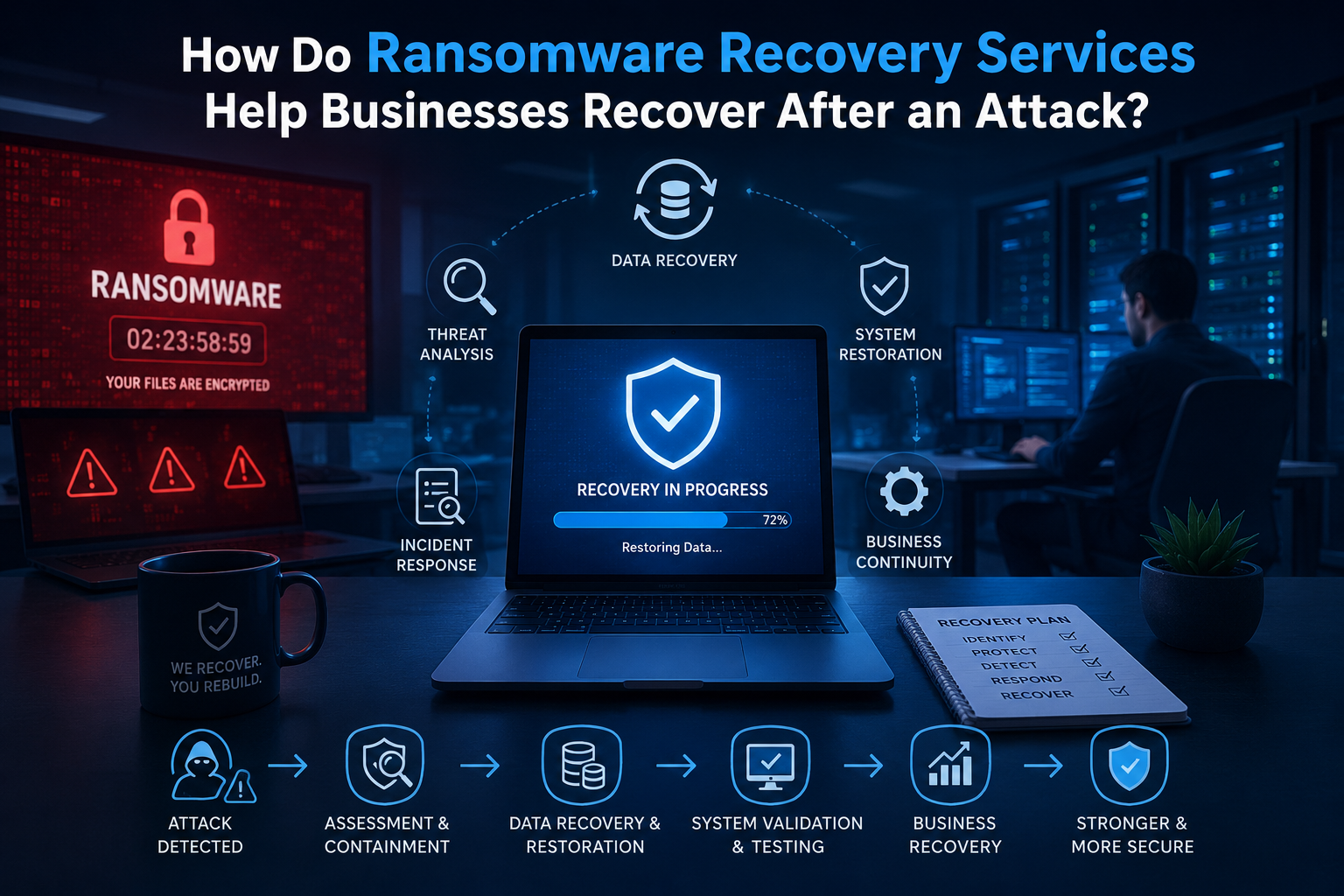
What a Modern Enterprise Ransomware Recovery Workflow Should Look Like
Industry-leading recovery solutions streamline the end-to-end workflow, reducing downtime and ensuring integrity. A high-maturity workflow includes
1. Quick Incident Detection and Isolation
- Quickly identify malicious behaviour related to encryption
- Automate the isolation of infected endpoints
- Make it impossible for an attacker to move laterally
2. Forensic-Based Assessment of Damage
- Analyse the malware involved in the attack
- Map the behaviours of the threat actors involved in the attack
- Determine the extent of the compromise
- Validate the integrity of restored files
3. Automated Initiation of Recovery
- Select validated restore points
- Use automated bare-metal or incremental restoration methods
- Restore the operating system, applications, configuration settings, and data from backup media
4. Continuous Monitoring and Validation
- Perform integrity checks on restored files during recovery
- Validate that all restored workloads are clean and functional
- Reinforce security controls
5. Hardening After an Incident
- Update all security policies
- Improve endpoint and identity posture
- Provide threat-intelligence-driven recommendations to improve the security of your organisation
This workflow significantly reduces Mean Time to Recovery (MTTR) while ensuring a clean, compliant restoration.
Best Practices for Ensuring Business Continuity
To stay operational during and after ransomware attacks, enterprises should:
1. Prioritise automated recovery
Automation reduces dependency on manual intervention and accelerates SLAs.
2. Adopt ransomware-resilient backups
Immutable, off-site, air-gapped, and versioned backups protect recovery integrity.
3. Implement Zero Trust principles
Strict identity verification and micro-segmentation limit ransomware spread.
4. Use threat-intelligence-powered protection
Live intelligence helps detect ransomware families earlier and block them more effectively.
5. Test recovery regularly
Periodic drills validate restore points, reduce friction, and prepare teams for real incidents.
6. Consider managed recovery services
Solutions like ransomware recovery as a service (RRaaS) provide expert-run, SLA-driven, and rapidly deployable recovery support.
Conclusion: Fast Recovery Defines Modern Cyber Resilience
Ransomware incidents will keep growing, but businesses will remain protected only by their ability to respond quickly and effectively. Effective enterprise ransomware recovery solutions minimise downtime, protect data integrity, and enable continued operations during extreme disruption.
As an example of a cloud-based anti-ransomware recovery solution, Seqrite Ransomware Recovery as a Service (RRaaS) offers the intelligence, automation, and speed required to keep pace with the current threat landscape.
Speed Up Your Ransomware Recovery Process Today
All businesses should strengthen their resilience against cybercriminal activity with Seqrite. Explore how RRaaS helps you recover faster, safer, and more predictably.






Write a comment ...